The transition from prototype manufacturing to stable batch production changes the requirements placed on aerospace suppliers.
Producing a single high-quality component is no longer enough. Manufacturers must achieve the same precision repeatedly, control production costs and deliver increasing volumes within shorter timeframes.
For Jiangxi Xinhang Aviation Technology Co., Ltd., this meant addressing four central requirements:
- Stable batch production
- Consistently high precision
- Competitive manufacturing costs
- Short and reliable delivery times
The company found its solution in the TOPNC i500 five-axis milling-turning machining center.
Complex aerospace components, fragmented processes
Aerospace components frequently combine demanding materials, thin-walled geometries and tight dimensional tolerances. These characteristics make machining particularly challenging.
Jiangxi Xinhang was confronted with several typical production issues:
- Difficult-to-machine materials
- Deformation of thin-walled components
- Multiple machining operations distributed across different machines
- Additional handling and setup between individual process steps
The existing manufacturing process required two machines and two operators. Each transfer between machines added handling time and created another point at which process deviations could occur.
As demand increased, this fragmented process became an obstacle to efficient batch production.
Complete machining in a single setup
Jiangxi Xinhang selected the TOPNC i500 to consolidate its production process.
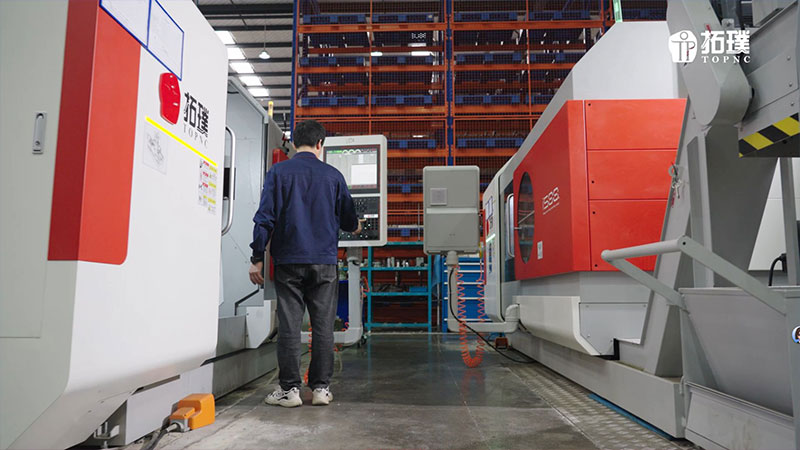
The five-axis milling-turning machining center combines milling and turning operations within a single machine. Complex components can therefore remain clamped while the required machining steps are completed.
TOPNC’s compact five-axis milling-turning machines are designed for small and medium-sized complex components and combine turning and milling operations in one setup. The technology incorporates high-speed rotary positioning as well as measurement and compensation functions intended to support precision throughout the machining process.
For Jiangxi Xinhang, the new process could be described in three simple terms:
One machine. One setup. One operator.
Consolidating the operations reduced machine changes, repeated clamping and internal component handling. It also simplified production planning and made the overall process easier to control.
Cycle time reduced by more than half
The new manufacturing process delivered measurable results.
An aviation component that previously required approximately eight hours could be completed in 3.5 hours using the TOPNC i500. This represents a cycle-time reduction of more than 56 percent.
At the same time, the production resources required for the component were significantly reduced:
| Production factor | Previous process | With TOPNC i500 |
|---|---|---|
| Cycle time | 8 hours | 3.5 hours |
| Machines | 2 | 1 |
| Operators | 2 | 1 |
| Required floor space | 100% | 50% |
The improvement was therefore not limited to machining speed. The new process reduced equipment requirements, operator involvement and the amount of production space needed by 50 percent.
Process engineering beyond the machine
Successful aerospace machining depends on more than machine performance alone. Materials, tools, machining strategies and process parameters must work together as one coordinated system.
TOPNC and Jiangxi Xinhang therefore worked jointly on the machining process for high-hardness and difficult-to-machine materials. The objective was not simply to install new equipment, but to develop a stable production solution combining the machine, the process and technical support.
This approach is particularly important in batch production. A fast individual machining cycle provides limited value when the process cannot maintain the required quality over repeated production runs.
The real benchmark is repeatability: stable dimensions, predictable cycle times and reliable output across every component in the batch.
A second i500 within six months
The operational results led Jiangxi Xinhang to place an order for a second TOPNC i500 less than six months after the first machine entered production.
This follow-up order demonstrates that the first installation did more than solve an isolated production problem. The process proved suitable for continued use and further expansion within the company’s manufacturing environment.
Supporting the industrialisation of large-aircraft production
As the production volumes of China’s domestically developed large aircraft continue to grow, the aerospace supply chain must move from project-based manufacturing towards stable industrial production.
This transition requires manufacturing systems capable of delivering complex components at high precision, competitive cost and repeatable quality.
The Jiangxi Xinhang project shows how integrated five-axis milling and turning can contribute to that transition. By replacing a fragmented multi-machine process with complete machining in one setup, the TOPNC i500 reduced cycle time, resource requirements and floor-space demand at the same time.
It is a practical example of how high-end machine tools developed in China are helping aerospace manufacturers build the productivity and process stability required for large-scale aircraft production.